- Many people report sleep problems during a full moon.
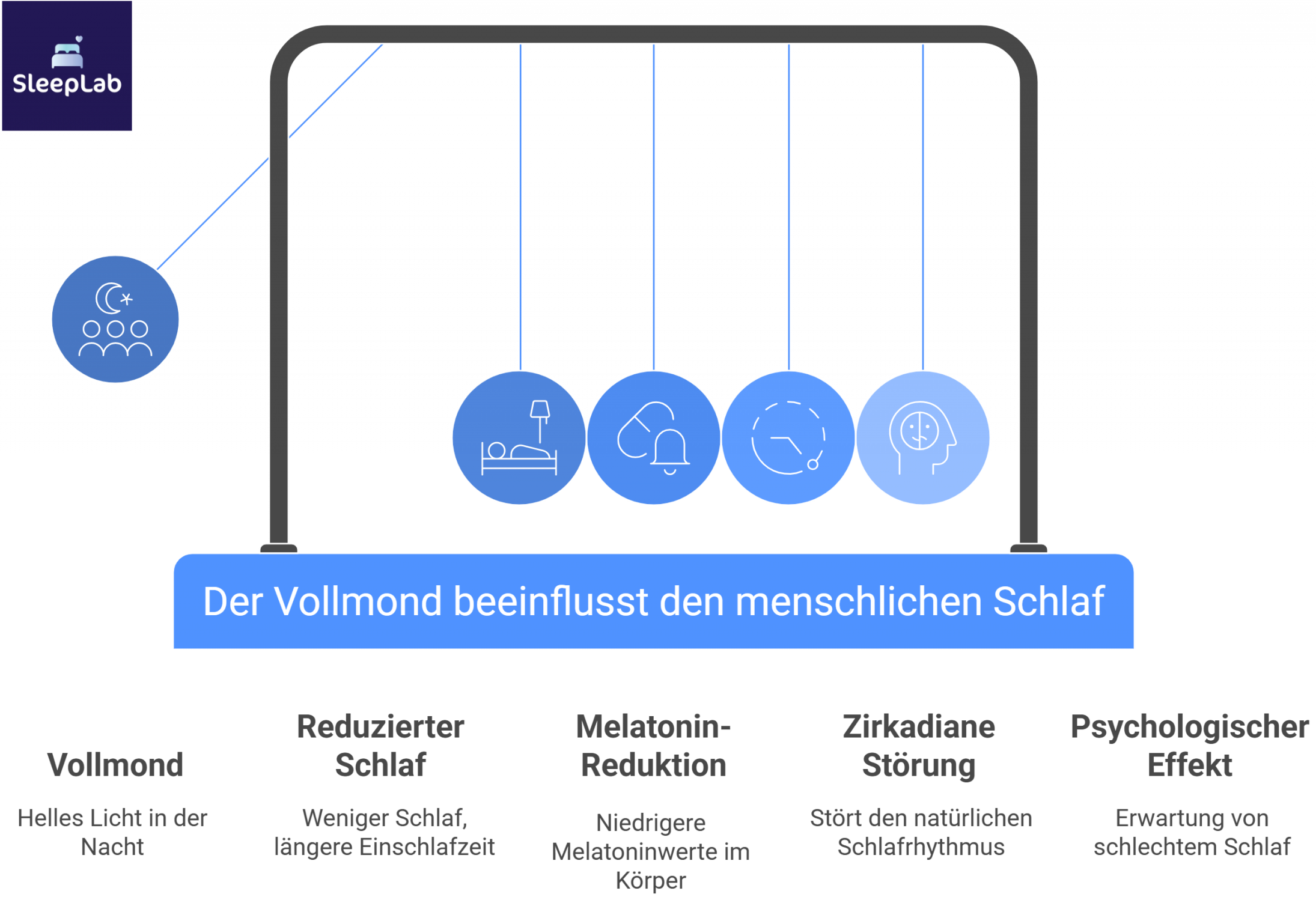
- Studies sometimes show effects such as longer time to fall asleep and less sleep, while others show no differences.
- Possible causes: moonlight, circadian disturbances, psychological expectation effects.
- Subjective perception often plays a greater role than measurable data.
- The influence can be reduced through routines, darkness, and relaxation techniques.
Many people report sleeping worse during a full moon. Some lie awake longer, others sleep more restlessly, wake up more frequently, or feel exhausted the next morning. This phenomenon is not only described anecdotally but is also the subject of numerous discussions on social networks, sleep blogs, and scientific forums. Many affected individuals specifically search for terms like «moon sleep» or «full moon sleep» to understand whether the current lunar phase could be affecting their sleep ( 1 ).
What’s particularly interesting is that it’s not just the full moon that’s suspected of affecting sleep. Waxing and waning moons are also frequently linked to sleep disturbances , vivid dreams, or changes in sleep patterns . Search engine queries like «waning moon sleep» or «current moon sleep» are common, demonstrating how much this topic concerns many people ( 1 ).
But how much truth is there to the perceived influence of the moon on our sleep? Is it pure imagination, or are there scientifically verifiable connections? And how can you sleep better if you actually feel influenced by the phases of the moon?
What science says about the moon and sleep
Numerous scientific studies have investigated the potential influence of lunar phases on human sleep, with sometimes contradictory results. Some studies suggest that the full moon may be associated with reduced sleep efficiency, longer sleep onset time, and a shorter total sleep duration. Other research, however, found no statistically significant effects ( 1 ), ( 2 ), ( 3 ).
Here is an overview of key findings:
- A widely cited study from the University of Basel (2013) found that subjects slept an average of 20 minutes less, fell asleep more slowly and had lower melatonin levels during a full moon ( 1 ).
- Other meta-analyses, e.g. with several hundred participants, have not been able to demonstrate a consistent relationship between lunar phases and objective sleep parameters such as deep sleep duration or REM sleep content ( 1 ).
- One possible physiological explanation: On cloudless nights, the increased moonlight can break through the natural darkness, especially in poorly darkened rooms. This can disrupt the circadian rhythm, particularly in people with increased light sensitivity ( 1 ).
- In addition, there is a psychological effect: People who know it’s a full moon subconsciously expect poor sleep, which can lead to a so-called self-fulfilling prophecy. Studies on the nocebo effect show that the mere anticipation of a problem can increase the likelihood of its occurrence ( 1 ).
- Furthermore, there is evidence that in certain individuals there may be a stronger synchronization of the sleep-wake rhythm with the lunar cycle, similar to the effect of light on seasonal sleep patterns ( 1 ).
Conclusion: The data is inconsistent, but for some people the moon does indeed seem to have a noticeable influence on sleep patterns, whether due to biological or psychological reasons.
Moon phases and subjective sleep perception
Even though the moon’s influence cannot always be objectively measured, subjective sleep perception remains a key factor. Many people report feeling unrested or having more difficulty falling asleep during certain lunar phases, especially during a full moon. These individual observations deserve attention because they often influence our well-being more than measurable data. Those who suffer from poor sleep during a full moon usually notice this change clearly, even if it cannot always be objectively confirmed in scientific studies.
Typical subjective effects of lunar phases:
- Insomnia during full moon: difficulty falling asleep or frequent awakenings during the night ( 2 ).
- More intense dreams or nightmares: Many people report having more vivid dreams, especially during a waxing moon ( 2 ).
- Restless sleep: Frequent tossing and turning, waking up easily, or the feeling of not having slept through the night. Such experiences often lead to the assumption that full moons cause poor sleep or that poor sleep during a full moon is not just an isolated case, but widespread, especially among sensitive sleepers ( 2 ).
- Increased irritability and fatigue the following day: Especially in people with a sensitive sleep-wake cycle ( 2 ).
- Poor sleep during a full moon: Many people report difficulty falling asleep, restless sleep, or waking up more frequently on these nights ( 2 ).
An important aspect is internal expectation. People who have repeatedly experienced poor sleep during a full moon often develop heightened awareness of these nights, which can further amplify the effect. Studies on the so-called nocebo effect show that those who are convinced they sleep worse during a full moon are highly likely to experience exactly that. This expectation can unconsciously create stress – and thus actually reduce sleep quality.
Cultural influences also play a role: In many traditions, the full moon is considered energetically charged or a trigger for restlessness. Such collective beliefs reinforce individual perceptions and can lead to a heightened focus on sleep problems.
How to sleep better despite a full moon
If you notice that you are sensitive to the moon’s influence, you can take targeted countermeasures. Especially on nights when the lunar phase indicates a particular influence on sleep, conscious sleep preparation is worthwhile. Those who want to better understand sleep during a full moon should regularly observe how light conditions, personal mood, and sleep patterns interact. Even small adjustments to your evening routine or sleep environment can make a big difference.
-
Control light sources:
- Blackout curtains or sleep masks help to block out disturbing moonlight.
- Reduce screen time in the evening and use warm, dimmed light.
-
Establish an evening routine:
- Gentle activities such as reading, a foot bath, or relaxing yoga prepare the body and mind for falling asleep.
- Breathing exercises or short meditation sessions lower stress levels and promote inner peace.
-
Pay attention to good sleep hygiene:
- Try to go to bed at the same time every day, even on weekends.
- Ensure a comfortable room temperature (ideally 16-19 °C) and avoid sources of noise.
-
Relieve internal pressure:
- Realize that not every night has to be perfect. Even if your sleep is restless one night, it doesn’t automatically mean you’ll be exhausted the next day.
- If necessary, a short power nap during the day can help compensate for the lack of sleep, provided it is not too late.
-
Keep a sleep log:
- If you suspect that your sleep is related to the phases of the moon, keep a sleep diary. This will help you identify patterns and gain clarity as to whether there is a connection or whether other factors are dominant.
These measures not only strengthen your resilience to external influences such as the moon, but also generally promote more restful sleep.
Conclusion: The moon primarily influences how we experience sleep.
Whether waxing or waning moon, full moon or new moon: the effects on sleep vary from person to person. While the effect hasn’t been definitively proven scientifically, the subjective experience of many people suggests a certain influence. By consciously examining your own sleep patterns, you can reduce potential disruptive factors like light or stress and enjoy a more restful night, even under a bright moonlit sky. Especially if you find sleeping under a full moon challenging, routines, sleep logs, and targeted relaxation techniques can help you better manage this influence.
Ein erholsamer Schlaf hängt nicht nur von Gewohnheiten oder körperlichen Faktoren ab, sondern auch von der Qualität der Schlafunterlage. Wer seine Schlafsituation ganzheitlich verbessern möchte, kann sich zusätzlich einen Überblick über moderne Matratzenlösungen verschaffen – etwa in der Technogel Matratzen Bewertung für gezielte Druckentlastung, der Hasena Matratzen Bewertung mit Fokus auf ergonomische Unterstützung oder der Happy Matratzen Bewertung für ausgewogenen Schlafkomfort. Die passende Matratze kann dabei helfen, nächtliche Unruhe zu reduzieren und die Regeneration im Schlaf zu unterstützen.
Frequently asked questions about sleep disturbances during a full moon
Why is it so difficult to sleep during a full moon?
Some studies conducted under controlled laboratory conditions report a shortened deep sleep phase, longer sleep onset time (approximately 5 minutes), and about 20 minutes less total sleep, as well as reduced melatonin levels, during a full moon.
However, other large, population-based studies find no significant effect of lunar phases on sleep quality or duration.
One possible explanation is that poorer sleep is perceived when there is a corresponding expectation: a nocebo effect ( 4 ), ( 5 ).
How long do sleep problems last during a full moon?
Most effects observed in studies are limited to individual nights around the full moon phase – specifically, shortened sleep duration or reduced deep sleep. In population-based studies, sleep patterns remained stable over longer observation periods, without recurring full moon effects ( 6 ).
What symptoms occur during a full moon?
Many people report subjectively about:
-
Difficulty falling asleep and frequent waking up during the night ( 7 )
-
Restless sleep and more intense dreams ( 8 )
-
Increased fatigue or irritability the following day ( 8 ).
Objective studies occasionally show reduced deep sleep duration, longer sleep onset time and lower melatonin production ( 5 ).
What deficiency causes sleep disorders?
A specific hormone deficiency related to the moon, full moon, or sleep disturbance in general has not been proven. However, reduced melatonin production on certain full moon nights may play a role, if any ( 9 ).
What works immediately for sleep disorders?
Clear, dimming, completely blackout light (e.g., through blinds or sleep masks) usually helps immediately, especially on full moon nights. Relaxation rituals and a consistent evening routine also have a positive short-term effect ( 10 ).
Which hormone is responsible for deep sleep?
Deep sleep is characterized by EEG delta activity; the hormone melatonin supports falling asleep and a healthy sleep-wake rhythm ( 4 ).
Why do I wake up in the middle of the night and can’t fall back asleep?
Nighttime awakenings can have many causes: poor sleep-wake cycles, stress, environmental factors, or expectations (e.g., during a full moon). Often, the cause lies less in the lunar phase than in sleep hygiene or mental attitude ( 11 ).